In This Issue...
Have a story you want to share or a topic you would like us to cover?
Jeff Weighs In
Advocacy and Legal Update
Washington Update
by Artemis Policy Group
On April 3rd, President Trump released his budget proposal for fiscal year (FY) 2027. Many of its specifics are similar to what the Administration proposed for FY26. Here are the items that are most relevant to HTCs:
- HRSA: President Trump again seeks to move basically all programs currently housed at the Health Resources and Services Administration (HRSA) to a (proposed) new agency that would be called the Administration for a Healthy America (AHA). We believe the proposed transfer would include the National Hemophilia Program at HRSA, but the budget documents released to date aren’t detailed enough to be certain. The Maternal and Child Health Bureau and the Special Projects of Regional and National Significance that are the parent programs for the hemophilia program would move.
- CDC: President Trump again proposes to move many programs currently housed at the Centers for Disease Control and Prevention (CDC) to AHA. The budget is explicit that the activities of the Division of Blood Disorders would move. The proposal would merge the hemophilia and hemophilia treatment center budget lines into one line but would continue to fund the combined program at current levels.
- OPA: Finally, President Trump again proposes moving the Office of Pharmacy Affairs that administers the 340B Program to the Centers for Medicare and Medicaid Services (CMS). He would also increase funding for the program significantly to allow OPA to conduct more oversight.
Please remember that, while the President’s Budget outlines the Administration’s priorities, ultimately Congress decides the funding levels for federal programs and decides where they are located. Last year, Congress rejected the President’s FY26 proposal to reorganize HHS and instead opted to provide level funding for the CDC and HRSA hemophilia programs.
The Hemophilia Alliance along with national patient advocacy partners are working to encourage Congress to fund the hemophilia programs for FY27. Most recently, the Hemophilia Alliance participated in advocacy to ask Senators to co-sign Senator Ed Markey’s Dear Colleague letter in support of the federal bleeding disorders programs. We are pleased to report that 9 Senators joined that letter recognizing the value of HTC-provided care and expressing support for the HRSA and CDC hemophilia programs.
Protecting Medicaid Patients
As previously reported, the One Big Beautiful Bill Act (Public Law 119-21) enacted in 2025 will bring major changes to Medicaid and Marketplace coverage for HTC patients and millions of other Americans. One of the law’s most significant changes will require Medicaid expansion states to implement “community engagement” [work] requirements for certain adult Medicaid applicants and enrollees. Beginning next year (in most states), individuals who fail to comply will lose their Medicaid coverage, unless they meet specified criteria for an exemption. One of the grounds for exemption is “medical frailty,” which the law defines as encompassing individuals with “serious or complex medical conditions.”
It is the position of the Hemophilia Alliance, the National Bleeding Disorders Foundation, Hemophilia Federation of America, and the Coalition for Hemophilia B that bleeding disorders constitute “serious or complex medical conditions” and therefore are grounds for exemption from the community engagement requirements. Importantly, medical frailty does not require a finding that an individual can’t work; medical frailty means, rather, that the individual lives with a serious or complex medical condition that puts them at risk if they lose their Medicaid coverage.
The national partners have written to CMS and copied state Medicaid directors, setting forth this position. In March and April, the Hemophilia Alliance led a second phase of outreach, working with HTCs and chapters to reinforce this crucial message with their respective state Medicaid agencies. Thank you to Alliance members who joined us in this effort! The Hemophilia Alliance will continue working with community partners to mitigate, as far as possible, unnecessary and dangerous coverage losses for individuals who live with bleeding disorders.
The Hemophilia Alliance has developed a summary overview of the coming Medicaid changes that may be helpful to HTC teams. We have also developed a one-pager that HTCs can personalize and use as they begin to educate patients about the new requirements. We work for you!
Member and Community Relations Update
Opportunity to Contract for Home Health Nursing Services with BrightStar
by Elizabeth (Issie) Karan and Jennifer Borrillo
The Hemophilia Alliance has begun collaborating with BrightStar, which is a network of hundreds of independently owned and operated agencies that could be a potential source for home health nursing services for Hemophilia Treatment Centers (HTCs). HTCs needing nursing services should reach out to their primary contact at the Hemophilia Alliance who can provide the terms, rates, and the process for intake under the national arrangement. If HTCs wish to pursue nursing services directly with their local BrightStar agency or any other entity or outlet, that remains an option.
The Alliance and the national BrightStar organization have agreed to a set of terms and rates for the provision of skilled nursing and other professional services to patients of HTCs with which local agencies will comply. However, prior to completing intake with BrightStar, HTCs should independently evaluate these terms and rates and undertake their typical processes for contracting with a new vendor, including complying with any institutional requirements. Additionally, we recommend that HTCs enter into a separate contract for these services.
HTCs with existing agreements with local BrightStar agencies can continue to utilize services through those arrangements and mechanisms for requesting services. If HTCs intend to use their existing arrangements with local BrightStar agencies, they should not use the HA intake form or processes and should, instead, continue to follow established procedures.
The Hemophilia Alliance is ready to help connect HTCs with BrightStar and ensure the collaboration aligns with national standards. If you are interested in more details, please reach out to the Hemophilia Alliance.
When Formularies Fail: The Policy Breakdown Driving Hemophilia Drug Denials and How Patients and HTCs Can Fight Back
by Jennifer Borrillo and Miriam Goldstein
“How does a hemophilia patient obtain their lifesaving medication when their health plan no longer includes their drug on the plan’s specialty drug formulary?”
With the start of a new health plan year, some commercially insured HTC patients – and the HTCs who serve them – are once again discovering that patients’ medications have been dropped from their health plan formularies. The Hemophilia Alliance is aware of formularies that, for example, list only a single clotting factor, or (alternatively) include only a single non-factor product for prevention of bleeding. These narrow formularies create challenging issues for HTCs and patients alike. A medication used to treat hemophilia A does not work for a patient with factor IX deficiency; an agent indicated solely for prophylaxis will do nothing to halt breakthrough bleeding; and an IV-administered product may be an unacceptable option for an infant who is stable on an injected therapy – to note just a few examples.
Narrow formulary designs, unfortunately, are technically allowable under existing law. However, the Hemophilia Alliance in tandem with national partners is advocating for more robust standards, to provide a foundation for balanced formularies that meet the needs of the full patient community. As this advocacy continues, HTCs have tools and a key role to play in ensuring that patients can access the medications they need in order to live healthy lives.
Strengthening formulary adequacy standards: Current federal regulations governing formulary adequacy say that formularies must cover at least one drug per USP (US Pharmacopeia) category and class. There are two problems with this benchmark. First, the rule cites a USP classification system that comprises only drugs covered under Medicare Part D – but of course most bleeding disorders products are covered under Medicare Part B, so they don’t appear on that USP listing. Second, a separate USP list that does include Part B drugs also has major flaws, insofar as it groups all bleeding disorders medications in one single category and class, without regard to disease treated, prophylactic vs. acute indication, route of administration, etc. Due to these limitations, even the narrowest formularies can claim to be compliant with existing USP-based standards for formulary adequacy.
The Hemophilia Alliance and national bleeding disorders patient groups have undertaken a sustained, multi-pronged campaign to address the issue of formulary inadequacy. We are engaging with USP via letters and meetings, urging that body to revise its drug classification system to appropriately differentiate among bleeding disorders products based on condition and population treated, mechanism of action, and route of administration. We also continue to advocate with federal health and insurance regulators for better enforcement of existing standards; this includes urging regulators to give full weight to qualitative standards in existing law and protect patients against discriminatory plan benefit designs, including inadequate formularies.
Accessing medication TODAY: Meanwhile, patients still need access to their medication. Here are steps that patients and HTCs can take now when they encounter formulary exclusions and denials.
First and foremost, do not take “no” as a final answer! The patient has legal rights to appeal and/or to file a request for an exception. You (the HTC) play a critical role in that process.
- File an Urgent Formulary Exception Request: The HTC should immediately submit a “Formulary Exception Request” or “Prior Authorization” request, making the case that the patient’s medication is medically necessary. Provide documentation including (1) the patient’s treatment records and clinical history, and (2) journal articles or treatment guidelines supporting the use of prescribed medication.
- Highlight Clinical Distinctions: There are important clinical differences between and among bleeding disorder medications based on: condition treated; prophylactic vs. acute indication; mechanism of action (factor replacement vs. non-factor); half-life; mode of administration; etc. Describe how this specific prescription is carefully tailored to the patient’s health needs.
- Use the “Step Therapy” Rule Against Them: If the plan demands that the patient try a different, specified product first (“step therapy” or “fail first”), explain why that course of action could be clinically dangerous. Include information on any other treatment regimens previously tried by the patient that proved to be ineffective or harmful.
- Request a Peer-to-Peer Review: Ask for the opportunity for your hematologist to speak directly with the health plan’s medical director to explain the clinical necessity of the patient’s prescribed medicine.
- File an Internal and External Appeal: If the exceptions request is denied, file for an internal appeal and, if necessary, an external review (by an independent third party). Make sure to file these appeals within the timeframes specified by the health plan.
- Contact Patient Assistance Programs: If your patient is in immediate need, reach out to the manufacturer’s patient assistance programs for bridging medication while appealing.
Please contact your MCR primary contact if you have questions or need assistance navigating these steps.
Administration and Operations Update
Unlocking Insights: Hemophilia Alliance Data Portal
by Admin & Ops Team
The Hemophilia Alliance continues to advance our resources for our member HTCs. One of the tools we are pleased to provide is the Hemophilia Alliance Data Portal. The Data Portal assists Alliance members in tracking monthly product purchases.
Benefits of tracking monthly purchases made under the Alliance GPO contracts are:
- Improved HTC pharmacy business insights
- Informed decision making
- Greater potential for savings and rebates
This month saw the rollout of several required updates in the Data Portal, along with additional enhancements. In addition to manual entry, you may now use downloadable .csv templates to bulk upload product purchase data for multiple months or for an entire quarter in a single submission.
If you have any questions about our data portal or about who at your HTC is using the data portal, please reach out to Jennifer Anders Rose.
Data Portal FAQs:
- Data Portal Log in: Your data portal login is separate from your Alliance member website login
- Data Portal Password: Never share your password for the data portal
28th Annual Linda Gammage Social Work Conference – A Success!!
by Diane Bartlett, LCSW (she/her)—St. Luke’s Hemophilia Center, Boise, ID
Sixty-seven member HTC social workers from across the country gathered in Oklahoma City for the 28th Annual Linda Gammage Social Work Conference in February. This year’s conference focused on providing education and clinical skills for Solution Focused Brief Practice and Safety, Well Being and Ethical Decision Making in our personal and professional lives. Attendees found the sessions to be engaging, practical and helpful information for their practice. In addition, meaningful reflection and conversations were had by attendees against the sobering backdrop of the deadliest act of domestic terrorism in U.S. history at the Alfred P. Murrah Federal Building on April 19, 1995.
[Click on image for larger version]
The conference opened with a full-day training on Solution Focused Brief Practice (SFBP) led by Teri Pichot, LCSW, LAC, MAC, founder of Denver Center for Solution-Focused Brief Therapy. Using a solution-focused mindset, attendees learned techniques to use in the HTC setting to focus on what people want to achieve rather than on the problem(s) with which they are struggling.
Day two featured Emily Bartlett, LICSW, whose clinical work focuses on behavioral health, crisis management and trauma. Working as a co-response clinician in the Boston area, she partners with law enforcement to provide immediate, on-scene crisis intervention during 911 calls. Emily provided concrete solutions for assessing crisis/high-risk situations using situational, cultural, and self-awareness frameworks. Reviewing the ethical framework of social work practice and advocacy during the current climate was value-added.
The Linda Gammage Social Work Planning Committee and conference attendees extend a heartfelt thank you to CSL Behring for its continued support since the conference’s inception in 1997. The event remains a meaningful and impactful cornerstone for HTC social workers and their clinical practice.
As we look forward to next year’s conference, the planning committee is excited to announce our newest member: Molly Lippold-Meinholz, MSW, CAPSW (she/her), a social worker and Program Manager at University of Wisconsin Health’s Comprehensive Program for Bleeding Disorders.
Spring Member Meeting Highlights: What Members Are Talking About
by Admin & Ops Team
The 2026 Spring Member Meeting generated strong engagement and meaningful discussion, with evaluation feedback highlighting standout sessions and clear priorities for the future. Across both days, members consistently rated sessions highly and shared insights reflecting the real‑world challenges and opportunities facing HTCs.

AI in Healthcare, presented by invited speaker Sara E. Berger, emerged as the top‑rated session, praised as both eye‑opening and highly relevant as technology continues to shape healthcare delivery. Members also placed found particular value in Medicare and Medicaid updates, Washington policy insights, and practical HTC Spotlights that offered real‑world examples and actionable takeaways. Opportunities to connect—particularly through MCR breakouts and networking—were another significant highlight.
We extend special thanks to the centers and speakers who shared their expertise and innovative practices during the Center Spotlight sessions:
- Lisa Littner – Cincinnati Children’s Hospital
- Sean Ransom – Washington Center for Bleeding Disorders
- Dave Groller and Tina Tweedley – Alaska Bleeding Disorders Center
Your willingness to share experiences, lessons learned, and practical approaches continues to strengthen the Alliance and inspire peers across our community.
Looking ahead, members expressed strong interest in expanded business and operational content, with a focus on moving beyond identifying challenges to more solution‑focused conversations. Continued education on AI, a drug pipeline snapshot, and discussions related to workforce issues and advocacy were also among the most requested future topics.
Member feedback will continue to guide meeting planning as the Alliance balances technical content with interactive formats—ensuring sessions remain practical, engaging, and aligned with the evolving needs of HTCs nationwide.
2027 Alliance Meeting Calendar is Here!
by Admin Ops Team
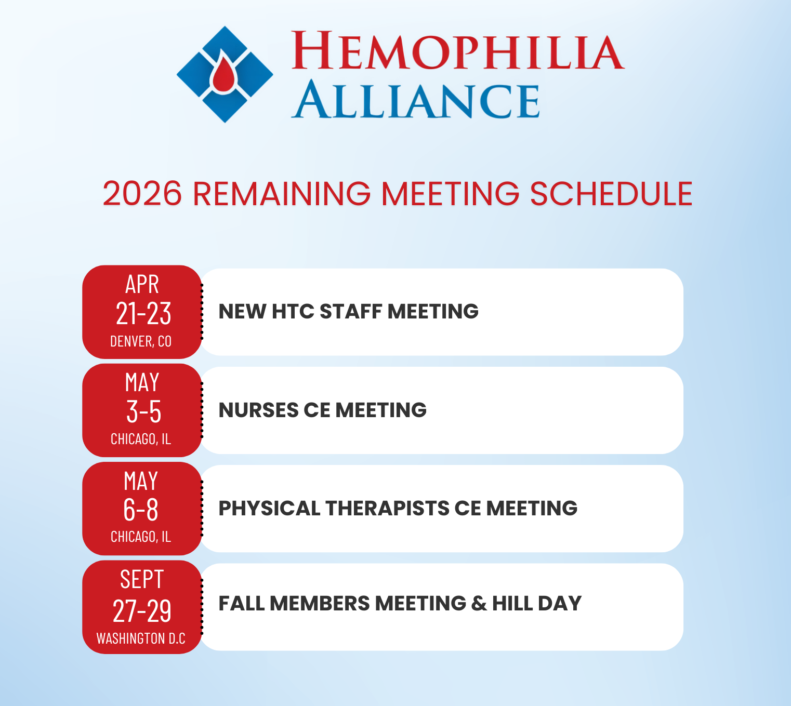
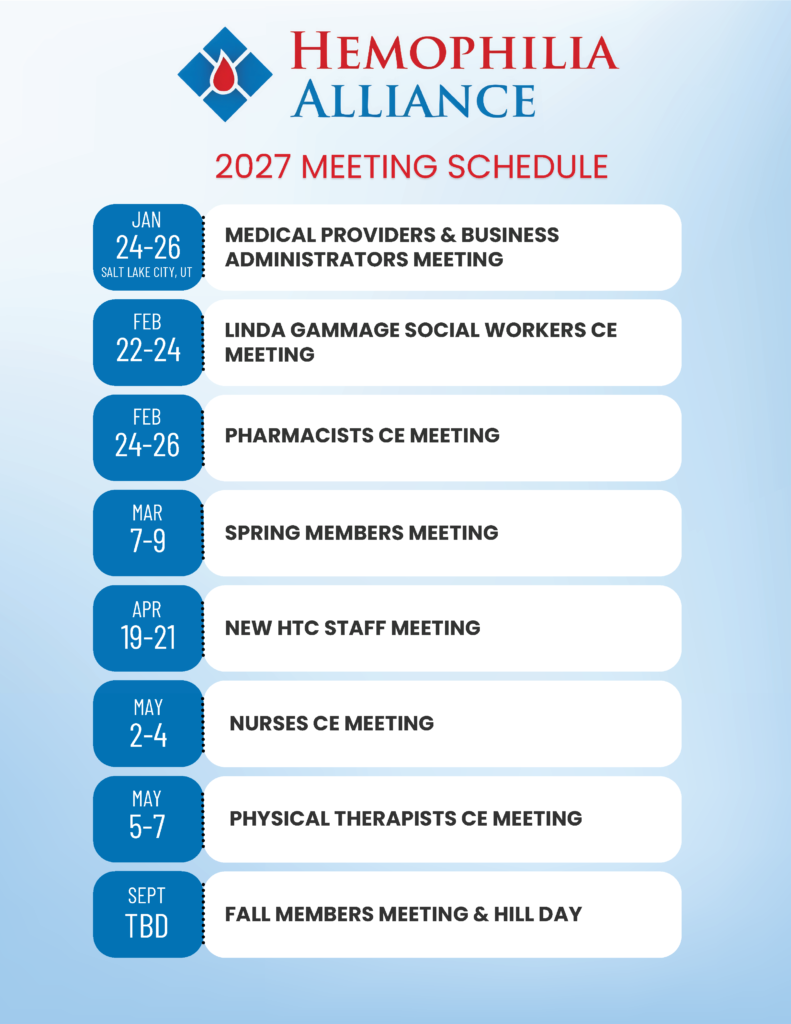
We are excited to share the 2027 meeting calendar, giving you plenty of time to plan. As a reminder, the Hemophilia Alliance hosts 9 annual in-person meetings, 4 of which offer CEUs. You can learn more about our member meetings through our Meeting FAQs. Your input helps shape these gatherings, so please reach out to your MCR contact or theresa@hemoalliance.org if you have suggestions about topics to include, a special guest speaker to invite, or ideas for breakout sessions.
Have a story you want to share or a topic you would like us to cover?

